Northwest Nazarene University has received significant new funding to advance its growing leadership in wildland fire research and collaboration. Currently awarded funding now exceeds $500,000, bringing NNU’s total wildfire research funding over the past decade to more than $1 million.
The most recent award comes from the National Science Foundation in support of a multi-institutional research proposal titled “Good Fire: Enhance Spatial and Temporal Efficacy of Prescribed Fire and Managed Wildfire Use.” The $4 million collaborative grant includes more than $150,000 in direct funding to NNU over the next three years, along with additional funding to partner institutions that will support collaborative efforts benefiting NNU’s Computer Science program.
The project brings together researchers from Northwest Nazarene University, Boise State University, the University of New Mexico and the University of Oklahoma. The research focuses on improving the effectiveness of prescribed fire and managed wildfire use by enhancing the spatial and temporal precision of fire management practices—critical work in the face of increasing wildfire frequency and intensity across the western United States. By collaborating alongside a Carnegie R2 research institution and two R1 flagship universities, NNU continues to demonstrate that a regional university can lead and contribute meaningfully within nationally recognized research partnerships.
This NSF award follows recent increases in NNU’s existing funding through the U.S. Forest Service in support of its collaboration with the USFS Fuels Academy. That funding now totals approximately $350,000 over the next two years as part of a five-year sole-source agreement. Combined with the NSF award, NNU’s currently awarded wildfire research funding exceeds $500,000. The U.S. Forest Service has also expressed interest in expanding both funding and interdisciplinary collaboration across additional departments at NNU.
 Through these efforts, NNU Computer Science faculty and students are providing advanced “pyroecoinformatics” support: applying data science, modeling and computational tools to improve fire management training and decision-making. This growing collaboration positions NNU at the forefront of applied wildfire science research in partnership with federal agencies and regional universities.
Looking ahead, the University is preparing budgets for an additional collaboration through its Forest Service partnership. Existing funding collaborators already include Education, with faculty and students contributing meaningfully to the project’straining and outreach components. Future collaboration may also involve Ecology, Visual Arts and Communications, including potential work with English faculty to support user documentation and communication tools developed by Computer Science students. This expansion reflects a comprehensive, interdisciplinary approach to addressing one of the most pressing environmental challenges of our time.
“Wildland fire management is one of the most complex and urgent difficulties facing our region,” said Dr. Dale Hamilton, professor of Computer Science at Northwest Nazarene University. “Through our work in pyroecoinformatics, we’re helping bring together data science, modeling and field application to support better decision-making in prescribed fire and managed wildfire use. What makes this especially meaningful is that our students are actively engaged in this research. They’re not just learning theory, they’re contributing to real solutions that support the U.S. Forest Service and communities across the West.”
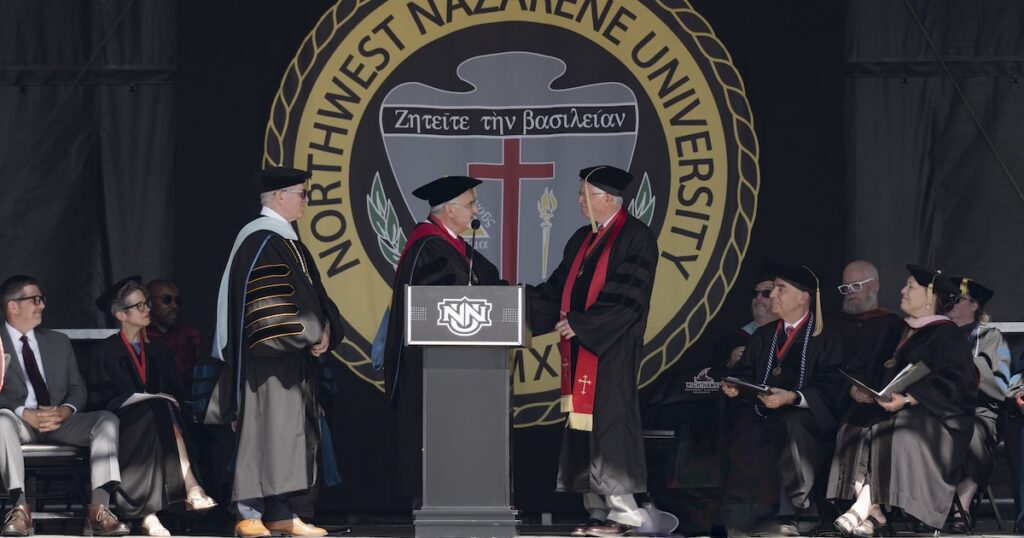
Dr. Mark DeMichael, president of Northwest Nazarene University, noted that the work reflects NNU’s commitment to scholarship that serves communities and strengthens partnerships.
“This kind of work reflects who we are at NNU,” said Dr. Mark DeMichael, president of Northwest Nazarene University. “We are committed to scholarship that prepares students to lead with both excellence and character. Our collaboration with the National Science Foundation and the U.S. Forest Service demonstrates what can happen when faith, intellectual rigor and community partnership come together. It is research that matters deeply; to our students, to our region and to the future stewardship of our world.”
Together, these awards represent not only significant external validation of NNU’s research capacity but also expanded opportunities for students to engage in high-impact, real-world research that benefits regional communities and national partners.
For more information about NNU’s Computer Science program and research initiatives, visit nnu.edu.